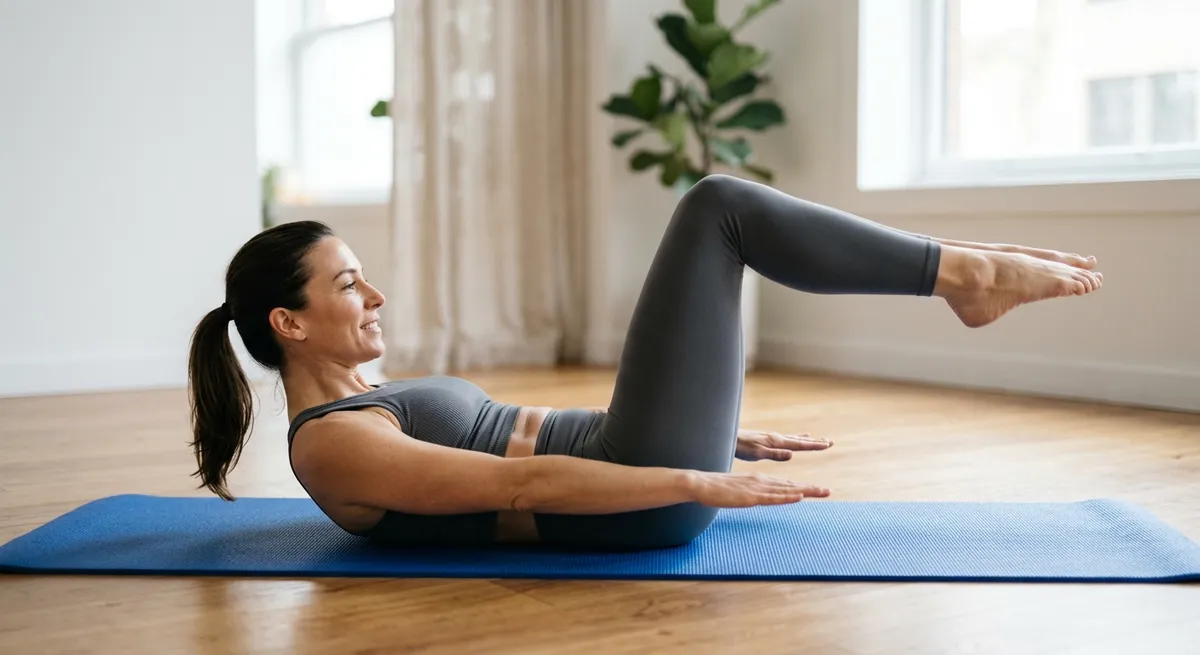
The Hundred doesn't look like much from across the room — you're lying on your back, legs lifted, arms pumping in small quick pulses. But Pilates instructors consistently point to it as the one daily move that builds the kind of core strength that actually matters: the deep stability that improves your posture, supports your balance, and makes everyday movement feel easier.
By the end of this guide, you'll know exactly how to perform the Hundred correctly, which beginner modifications make it accessible from day one, and what most people get wrong when they first try it.
What Makes the Hundred Different From a Crunch
Most people think of core training as ab training — crunches, sit-ups, anything that makes your stomach burn. The Hundred works differently. It targets the deep stabilizing muscles of your core, the ones that wrap around your spine and pelvis and keep you upright when you're carrying groceries or sitting at a desk for hours.
Crunches isolate a movement. The Hundred asks your entire core to hold a position while you actively breathe through it. That coordination of breath and sustained muscular effort is what Pilates instructors point to as the hidden key: you're not just building strength, you're training your nervous system to maintain stability while you move. That's functional core training.
The breath pattern — inhaling for five counts, exhaling for five counts, repeated ten times while your arms pulse — isn't decoration. It's the mechanism. Controlled breathing engages the diaphragm and the deep transverse abdominis simultaneously, creating internal pressure that supports the spine from the inside out.
How to Do the Hundred
You need nothing except a mat or a carpeted floor. Here's the full progression:
Step 1: Find Your Starting Position
Lie flat on your back with your knees bent and feet flat on the floor. Press your lower back gently into the mat — there should be minimal gap between your spine and the floor. This is your neutral pelvis, and holding it is the whole game.
Step 2: Lift Into Position
Inhale to prepare. On your exhale, curl your head and shoulders off the mat the way you would in a crunch, but stop there — you're not going higher. At the same time, extend your legs to a 45-degree angle from the floor (or keep knees bent if that's more manageable right now). Reach your arms long by your sides, hovering a few inches above the mat.
Step 3: Start the Pump and the Breath
Begin pumping your arms in small, controlled pulses — think of the motion as if you're patting something down firmly, about six inches up and down. Inhale through your nose for five pumps. Exhale through your mouth for five pumps. That's ten pulses, one breath cycle. Repeat ten full breath cycles for a total of 100 pumps — hence the name.
Step 4: Release Carefully
After your final exhale, bring your knees into your chest and lower your head slowly back to the mat. Don't just drop everything at once.
Beginner Modifications That Actually Work
If your lower back lifts off the mat or your neck starts aching within the first 20 pumps, these adjustments keep the exercise both effective and safe:
Keep your knees bent. Instead of extending your legs at 45 degrees, hold a tabletop position — shins parallel to the floor, knees stacked over hips. This dramatically reduces the lever arm pulling on your lower back.
Raise your leg height. Straight legs pointed toward the ceiling at 90 degrees are much easier to hold than at 45 degrees. As your core strengthens, you lower them gradually.
Rest your head down. If neck tension kicks in early, lower your head to the mat and just work the arm pumps and breath. You're still engaging the core from the breath pattern alone.
Start with 50. Five full breath cycles is a legitimate goal for day one. Build from there.
The Mistakes That Undercut Your Results
Holding your breath. The breath IS the exercise. If you're gripping and forgetting to breathe in the count, you're missing the core engagement that makes this work.
Pumping too big. Large arm swings recruit your shoulders instead of your core. Keep the range small and controlled — the effort should register in your center, not your upper body.
Letting your lower back arch. The moment your spine lifts away from the mat, your deep core has checked out. Lower your legs higher, bend your knees, or do both. There's no benefit in pushing through with compromised form.
Rushing the count. Five counts per inhale and five per exhale sets a deliberate pace. If you're finishing faster than that, you're shortchanging the breath mechanics.
What Daily Practice Actually Builds
Pilates instructors recommend the Hundred as a daily move specifically because it's short enough to be non-negotiable — you can complete all 100 pumps in under two minutes — and broad enough in its benefits to be worth that daily investment.
Over time, consistent practice supports better posture by training the muscles that hold your spine upright. It improves breathing mechanics by conditioning the diaphragm as an active part of core function. And it builds the kind of stability that transfers into everything else: how you sit, how you stand, how you move through the rest of your day.
Start with the modification that lets you hold perfect form from pump one to pump fifty, and build from there. The Hundred rewards patience more than effort — the control matters far more than the intensity.