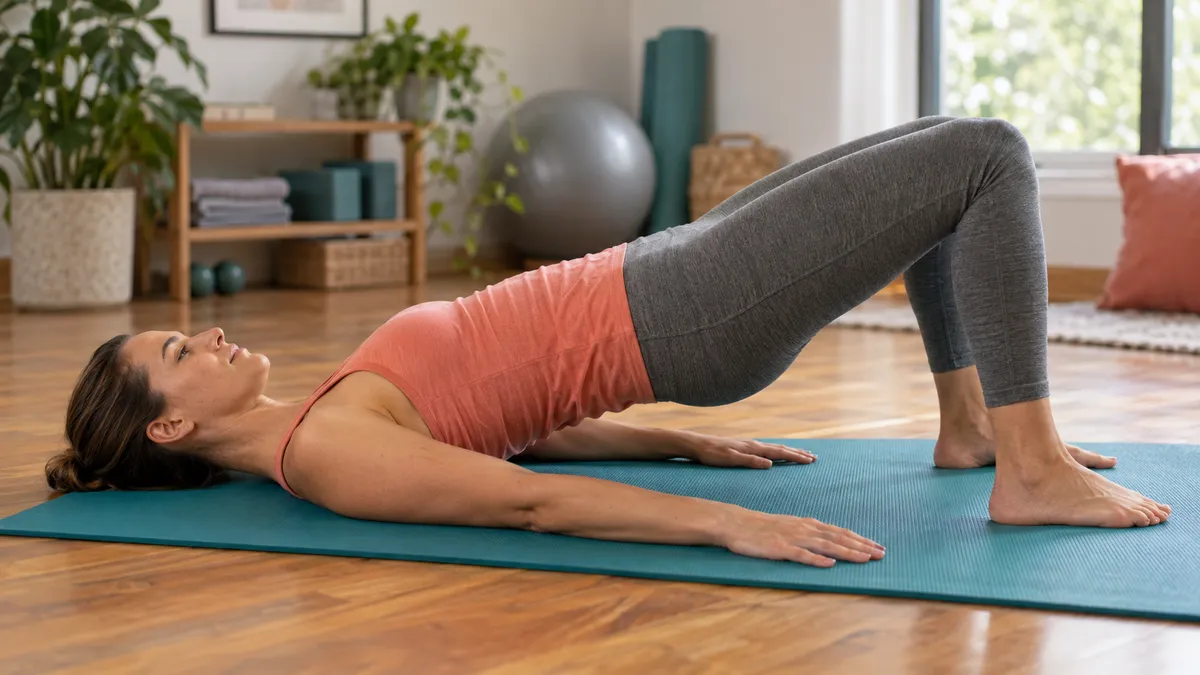
If you could keep only one Pilates move for the rest of your life, which would it be? Pilates instructor Nicole Hernandez has an answer, reported by Fitandwell: the pelvic curl. By the end of this article, you'll know how to do it with good form, what it should feel like, and how to make it easier or harder at home.
Why the Pelvic Curl Earns the Top Spot
Hernandez's case, per Fitandwell, is that the move is simple but powerful. It combines spinal mobility with strength in the glutes, hamstrings, and core. That's a lot of return for one exercise you can do on a mat in your living room.
This fits a broader appetite for low-impact, accessible workouts you can sustain at home. Think of it as a "minimum effective dose" move: little equipment, little space, several benefits at once.
The details below, from setup to cues, are general Pilates guidance and my own practical coaching, not quotes from Hernandez.
How to Do a Pelvic Curl, Step by Step
- Set up. Lie on your back with knees bent, feet flat on the floor about hip-width apart, arms resting by your sides.
- Find a neutral start. Let your spine settle comfortably. Relax your shoulders and jaw.
- Inhale to prepare. Let your ribs expand without flaring them upward.
- Exhale and curl. Gently tilt your pelvis so your tailbone lifts, then peel your spine off the mat one segment at a time.
- Pause at the top. Your body forms a long slope from shoulders to knees. Don't push your ribs up toward the ceiling.
- Inhale at the top. Keep your glutes and hamstrings working.
- Exhale and roll down. Lower slowly, upper back first and tailbone last, as if setting down one vertebra at a time.
Start with 5 to 8 slow repetitions. Slow is the point: the control is where the spinal mobility comes from.
What It Should Feel Like
The move combines spinal mobility with glute, hamstring, and core work, so check for all three:
- Spine: a smooth, sequential movement, not a single lift like a bridge.
- Glutes and hamstrings: steady effort in the back of your hips and thighs as you rise and hold.
- Core: a sense of abdominal support that keeps your ribs from popping up.
If you mostly feel it in your lower back or the front of your thighs, slow down and reset. Those are typical signs the movement is being driven from the wrong place.
Common Form Mistakes to Check
Lifting in one piece
If your back leaves the floor all at once, you're doing a bridge, not a curl. Start by tipping the pelvis, then think about peeling.
Overarching at the top
Pushing your hips as high as possible often means arching the lower back and flaring the ribs. Aim for a long line, not maximum height.
Rushing the way down
Dropping back to the mat skips half the benefit. Lowering with control keeps the work going.
Tensing the neck and shoulders
Keep your neck long and your shoulders heavy. Press gently through your arms if that helps, but don't grip.
Make It Easier or Harder
These are simple adjustments, my suggestions rather than anything from Hernandez.
Easier
- Shrink the range. Lift only as high as you can keep the movement smooth.
- Practice just the pelvic tilt first, without lifting.
- Slow your breathing and take an extra breath at the bottom to reset.
Harder
- Add a 3-breath hold at the top.
- Slow the roll down to a count of five or more.
- Try the move with feet slightly closer together, keeping your hips level.
A Quick 5-Minute Way to Use It
You don't need a full class. Try this:
- Minute 1: Gentle pelvic tilts on your back, to find the motion.
- Minutes 2 to 4: Pelvic curls, 3 sets of 5 slow reps with a breath between sets.
- Minute 5: Hug your knees to your chest and rock slightly to release your back.
Do it in the morning before work or in the evening as a wind-down. Because it's low-impact and needs only a mat, it's easy to keep up as a habit.
Why Simple Moves Last
The appeal of Hernandez's pick is how unglamorous it is. You won't need a reformer or a complicated sequence, just attention to how your spine moves. A move you can do almost anywhere is one you're more likely to keep doing.
Pick one spot this week, roll out a mat, and do five slow pelvic curls. Pay attention to the lowering phase, because that's where the move teaches you the most.